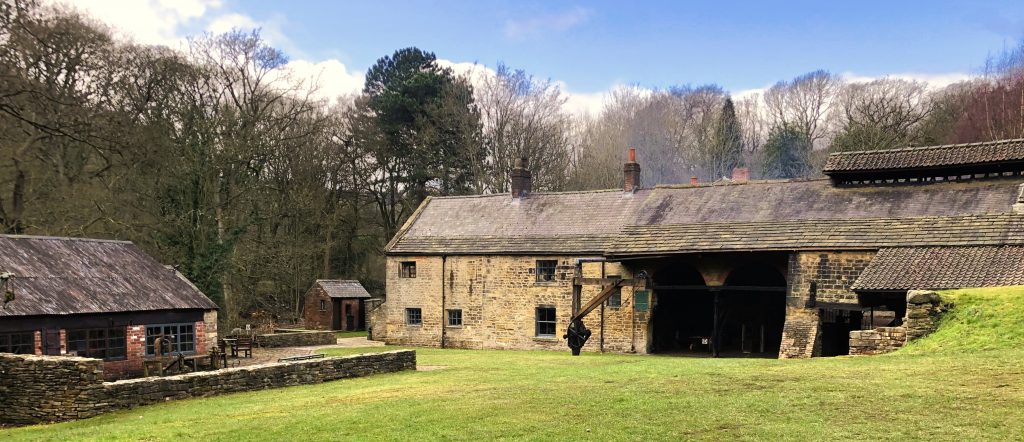
Built by Sir Francis Wortley, the earliest part of the Forge building can be dated back to the reign on King James 1st (1603-1625). The Forge was extended and improved by successive owners, the last alterations taking place in 1868. It has been restored to its appearance in Victorian times with furnaces, two belly helve hammers that were used for forging railway axles and mechanical bellows. The hammers and bellows were run by waterwheels which still work and are demonstrated to visitors.
The Ironmaster’s House was built next to the Forge. In Victorian times part of it was converted into two worker’s cottages and a section of it was incorporated into the Forge. The cottages now contain a museum room, 1900’s kitchen, washhouse and temporary displays. Further rooms are being restored.
The Workshops formerly housed Blacksmiths, a Joiner’s shop and Foundry which served several works on this stretch of the river Don. These buildings now contain vintage machinery, stationary steam engines and woodworking tools.
In front of the cottages is the new Smithy where our resident Blacksmith can often be seen at work, and the South Yorkshire Ironworks which contain a selection of machine tools.
The Forge
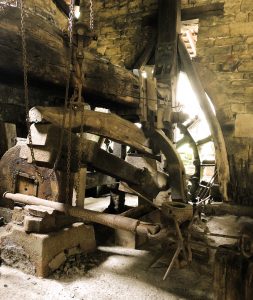
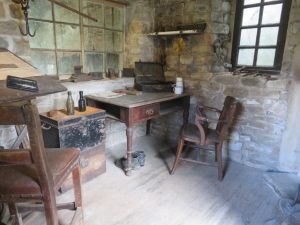
The Forge is the oldest part of the site and its industrial heart. In working days it would have been hot and noisy with the hammers and furnaces working 24 hours a day.
“It would almost have been impossible to have worked continuous without a break between heats, it was so intensely hot ……. We were expected to turn a certain tonnage out per day so the sooner we started the sooner we went home, no clocking in or out. In the summer time the furnace men would be cleaning the firebars & firing up & charging furnaces at 3.30am, we were going home or to the Bridge Inn at 3.30pm. The night shift would be doing the same at 4pm finishing at 3.30am.” (From the memoirs of Jim Shore, Furnaceman)
The Forge now looks as it would have done around 1900 and is set up to show how railway axles were made. The floor is paved with ‘Sheffield carpet’ (cast iron slabs), has a ’Jack roof’ to let out the heat and is overlooked by the Foreman’s office.
Looking around the walls it is possible to make out alterations that were made over the centuries, from the outline of a large open hearth on the front wall between the two wheels, to 17th century bricks and plaster in the end wall which was originally the inner wall of one of the bedrooms of the Ironmasters house.
Also displayed in the Forge is an 1825 rolling mill from Low Forge and wire drawing equipment.
The Workshops
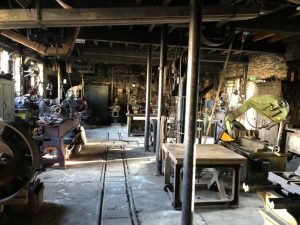
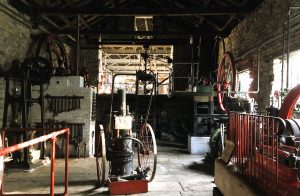
Behind the Forge and cottages are the workshops. Originally two buildings, one contained Blacksmith’s and Joiners’ shops, the other appears to have had varying uses and may have been used for brass founding in Victorian times.
The Blacksmiths’ shop now houses a range of machine tools mostly of early 1900’s vintage, these machines are still used by our engineers. The positions of three blacksmiths’ hearths can still be seen on the entrance door wall.
The Foundry contains steam engines which are now run on compressed air, the largest are an 1843 horizontal engine from Wilson’s snuff mill and an 1852 vertical engine from Neepsend gasworks mortar mill.
A range of small steam engines are displayed in the Joiners shop alongside lathes and a collection of woodworking tools and equipment.